

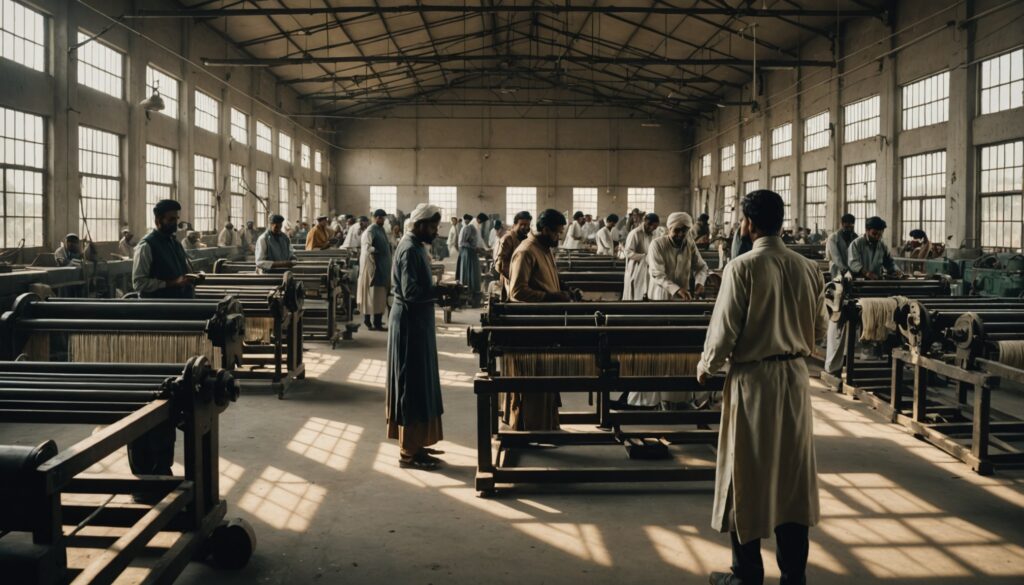

The numbers are devastating, and they’re getting worse by the week. Pakistan’s textile exports have plummeted to levels not seen since 2019, marking the sharpest decline in the country’s most resilient export sector. Garment orders that once flowed steadily from European and American retailers have dried up. Factories that ran double shifts are now operating three days a week. Workers who spent decades at the same mills are collecting pink slips instead of paychecks.
This isn’t just another cyclical dip in an industry that Pakistan has built its modern economy around. This time, the crisis cuts deeper. Global fashion retailers are sitting on bloated inventories. Consumer spending in the West has contracted. Supply chains that once favored cheap labor have diversified to Vietnam, Bangladesh, and now Cambodia. Meanwhile, Pakistan’s own energy crisis, inflation, and political uncertainty have made it an increasingly unattractive production hub.
## The Perfect Storm: When Everything Goes Wrong at Once
The textile collapse didn’t happen overnight, but it accelerated with brutal speed over the past eight months. Pakistan’s garment and textile exports fell to $13.2 billion in the fiscal year ending June 2024—down nearly 18 percent from the previous year. The decline has only steepened since. Exporters report order cancellations are arriving daily, and the pipeline of new contracts has nearly vanished.
Dr. Khalid Siraj, chairman of the Pakistan Business Council, spelled it out plainly: “We’re facing a perfect storm. Global demand is weak, freight costs remain elevated, and our currency volatility makes pricing contracts a nightmare. Buyers are shifting orders to competitors who can offer stability. We’ve lost market share we may never get back.”
The root causes are interlocking. First, Western retailers—from H&M to Walmart to Target—massively overordered during the pandemic. They hoarded inventory expecting post-lockdown consumer spending to soar. Instead, inflation hit households hard. People cut back on clothing purchases. Retailers found themselves with warehouses bursting with unsold merchandise. The natural response? Cancel orders for the next season. Slash orders for the one after that. Pakistan’s mills bore the brunt of these cancellations because they lacked the bargaining power of bigger suppliers in Vietnam or Bangladesh.
Second, Pakistan’s own economic crisis has made the country a difficult place to manufacture. The rupee has depreciated so severely that while it should theoretically make exports cheaper, it’s actually raised the cost of imported raw materials—cotton yarn, fabrics, dyes, chemicals. A textile mill importing 80 percent of its inputs faces a squeeze from both sides. Energy costs, particularly the price of natural gas, have tripled in some cases. Mills are rationing power for certain hours, forcing staggered production schedules that kill efficiency.
Third, and perhaps most painful, is the diversification of global supply chains. The pandemic taught multinational retailers a harsh lesson: don’t depend too heavily on any single country. Bangladesh saw enormous investment in new factories. Vietnam ramped up capacity. Now Ethiopia and Rwanda are being courted as emerging alternatives with cheaper labor and less volatile politics. Pakistan’s political instability—the military coup in 2022, the constitutional crisis, the postponed elections—sent a signal to corporate buyers: this isn’t a safe bet.
## The Human Cost Nobody’s Talking About
Behind the export statistics are real families. The textile industry employs roughly 1.5 million people directly and supports another 3 million indirectly through ancillary services. Spinning mills, weaving units, garment factories, and embroidery workshops are concentrated in Punjab and Sindh, but their shutdown ripples across the entire economy.
In Faisalabad, the Manchester of Pakistan, entire neighborhoods depend on textile wages. Schools lose students when families can’t afford fees. Small traders who service factory workers lose customers. Transporters who haul goods see income evaporate. A garment factory owner in Karachi, speaking on condition of anonymity, described the grim reality: “We’ve cut staff by 40 percent. The remaining workers are on reduced hours. Some of my senior supervisors—men who’ve worked for me 20 years—I had to let them go. There’s no work. What else can I do?”
Unions report mounting pressure on workers, some accepting wage cuts just to stay employed. Health and safety standards are being compromised as factories cut corners to survive. This is the brutal math of a race to the bottom.
## What Recovery Looks Like (Or Doesn’t)
Unlike past export crises, this one has no obvious quick fix. The industry can’t simply “wait it out” because the structural changes in global supply chains are permanent. Retailers aren’t going to reverse their shift to Vietnam and Bangladesh. Consumers aren’t suddenly going to triple their spending on clothes.
What Pakistan’s textile sector needs is transformation, and it’s not happening fast enough. The government has announced export rebates and tax incentives, but these are band-aids on a broken bone. Real recovery requires massive investment in technology—automation to boost productivity, digital tools to streamline supply chains, sustainability certifications to access premium markets.
Farseen Iqubal, a textile industry analyst based in Lahore, put it bluntly: “The old low-wage, high-volume model is dead. Pakistan either invests in high-end textiles—luxury fabrics, specialized products, ethical manufacturing—or it accepts continued decline. But that requires capital, stability, and patience. We have none of these right now.”
Some mills are trying. A handful of factories have invested in advanced spinning technology and are targeting niche markets—organic cotton, recycled polyester, technical textiles for sports and medical use. But these are exceptions. Most mills are in survival mode, not transformation mode.
## What This Means for Pakistan
The textile crisis isn’t just an industry problem. It’s a macroeconomic alarm bell. Pakistan’s FX reserves are fragile. Export earnings are crucial to servicing debt and stabilizing the rupee. When the country’s largest export sector contracts sharply, it destabilizes the entire economy. The government is already leaning on the IMF and bilateral lenders to bridge the gap. Workers losing jobs means less tax revenue and more pressure on social services.
Politically, this matters enormously. Economic hardship fuels discontent. Thousands of job losses in Punjab—Pakistan’s most politically sensitive province—can translate into electoral consequences. Regional disparity will widen as textile-dependent areas slide while Karachi’s services sector holds steadier.
The textile industry’s collapse also reflects something larger: Pakistan’s difficulty in competing in a globalized manufacturing economy. Without urgent reform—energy sector fixes, currency stability, anti-corruption measures, and genuine political stability—this won’t be the last sector to face decimation. The warning signs are already flashing in other manufacturing segments.
Recovery will take years, not quarters. And that’s only if everything goes right—if energy becomes affordable, if the rupee stabilizes, if global demand rebounds, and if Pakistani mills invest boldly in modernization. That’s a lot of “ifs” in a country where “if” is fast becoming a luxury.
Source: Pakistan interior minister in Iran amid continuing mediation efforts – Arab News